
Shark Attack Statistics: How Many Attacks and Deaths Happen Each Year?
Shark attack statistics give a more balanced picture than headlines usually do. Shark bites do happen, and some are fatal, but they remain rare worldwide. The International Shark Attack File, based at the Florida Museum of Natural History, is the leading scientific database for confirmed shark-bite investigations.
Quick shark attack statistics
Here are the most useful recent numbers at a glance:
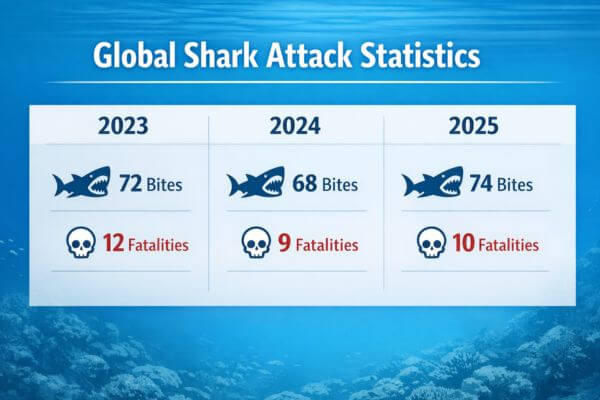
- 2025: 65 confirmed unprovoked shark bites worldwide
- 2025: 9 unprovoked fatalities worldwide
- 2024: 47 unprovoked shark bites worldwide
- 2024: 4 fatalities worldwide
- 2023: 69 unprovoked shark bites worldwide
- 2023: 10 unprovoked fatalities worldwide
These totals fluctuate from year to year, but they remain low compared with the huge number of people who swim, surf, dive, and paddle in the ocean.
How many shark attacks happen per year worldwide?
Recent ISAF totals show that confirmed unprovoked shark bites usually fall in the dozens, not the hundreds. That is the key point people often miss when reading scary headlines.
Recent worldwide totals:
- 2023: 69
- 2024: 47
- 2025: 65
How many shark attack deaths happen worldwide each year?
Fatal cases are much rarer than the total number of bites.
Recent unprovoked fatality totals:
- 2023: 10
- 2024: 4
- 2025: 9
That means most confirmed unprovoked shark bites are not fatal.
Fatal vs non-fatal shark attack statistics
This is one of the most important sections because it gives a real perspective.
- In 2025, 9 of 65 confirmed unprovoked bites were fatal
- In 2024, 4 of 47 were fatal
- In 2023, 10 of 69 were fatal
So while shark bites are serious, the majority of confirmed unprovoked cases do not end in death.
Where do most shark attacks happen?
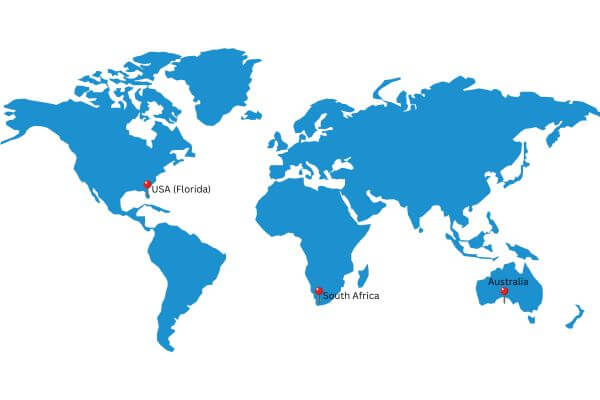
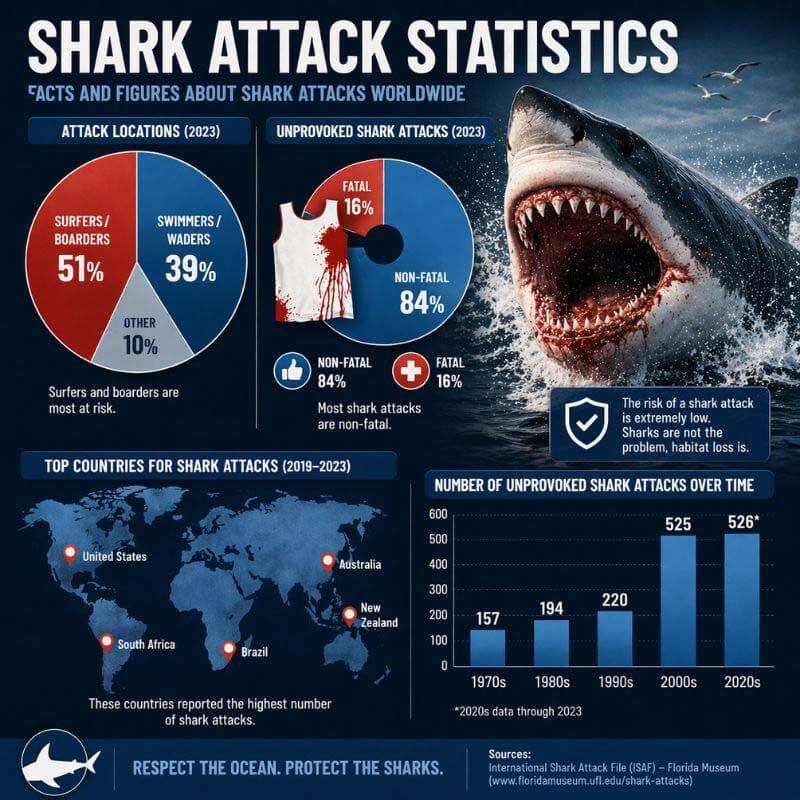
The United States consistently records the highest number of confirmed unprovoked bites, and Florida is the leading state within the U.S. In 2023, the U.S. recorded 36 confirmed unprovoked bites, and Florida alone accounted for 16 of them.
Other countries that feature regularly in annual reports include:
- Australia
- South Africa
- Brazil
- Bahamas in some years
South Africa is also one of the countries with the highest historical totals on ISAF’s long-term world map, although its annual totals are usually small.
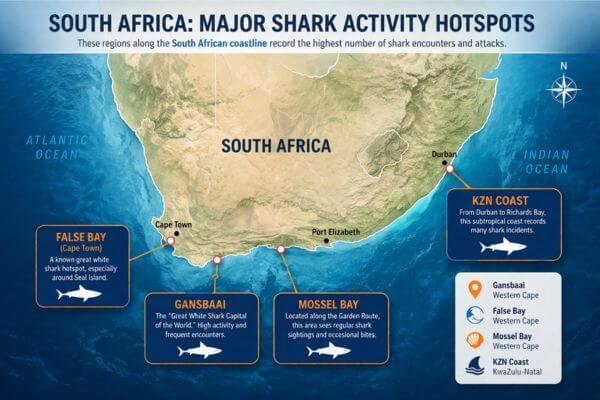
How many shark attacks happen in South Africa?
South Africa generally records only a few confirmed unprovoked bites each year. ISAF specifically noted that South Africa “averages a few bites a year.”
Recent South Africa figures include:
- 2022: 2 unprovoked attacks, 2 fatalities
- 2023: 2 unprovoked bites, 0 fatalities
- 2025: 1 fatal unprovoked bite reported
That pattern shows why one year should never be used alone to suggest a long-term trend.
How many shark attack deaths were there in South Africa in 2022 and 2023?
This part needed correction from the earlier version.
- 2022: 2 unprovoked attacks, both fatal
- 2023: 2 unprovoked bites, neither fatal
That is a sharp year-to-year difference, even with the same total number of incidents.
How many shark attack deaths were there in 2025?
Globally, ISAF reported:
- 12 confirmed shark-related fatalities total
- 9 of those were classified as unprovoked
ISAF also reported that in 2025:
- Australia had 3 unprovoked fatalities
- Vanuatu had 1
- Mozambique had 1
- South Africa had 1
How many shark attack deaths happen in the United States?
The U.S. leads the world in total confirmed unprovoked bites, but fatalities remain low relative to the total number of incidents. In 2023, the U.S. had:
- 36 confirmed unprovoked bites
- 2 fatalities
This supports the point that high totals in the U.S. are largely driven by heavy coastal use and exposure.
How many shark attack deaths happen in Florida?
Florida is often called the shark bite capital of the world because of its bite numbers, not because of a high death toll. In 2023, Florida recorded:
- 16 confirmed unprovoked bites
- 0 fatalities
ISAF also notes that many Florida bite cases likely involve smaller coastal requiem sharks, with blacktip sharks suspected in many cases.
How many shark attack deaths happen in Australia?
Australia is one of the world’s main shark-bite hotspots and can have more fatal cases than the U.S. in some years.
For 2023, ISAF reported:
- 15 unprovoked bites
- 4 fatalities
For 2024, the Australian Shark Incident Database reported:
- 19 total incidents
- 13 confirmed unprovoked bites
- 0 unprovoked fatalities
- 1 fatal provoked incident, linked to spearfishing
For 2025, ISAF reported Australia had:
- 21 unprovoked incidents
- 3 unprovoked fatalities
Which sharks are responsible for most attacks?
ISAF states that three species are repeatedly implicated as the primary attackers in serious human bite cases:
- White shark
- Tiger shark
- Bull shark
That said, ISAF also notes that many smaller requiem sharks are probably involved in more bites than they are formally credited for, because species-level identification is often difficult.
Why do shark attacks happen?
There is no single explanation for every bite incident. Researchers point to a mix of factors, including:
- Curiosity
- Mistaken identity
- Hunger or feeding motivation in some cases
- Environmental conditions that increase overlap between sharks and people
What matters most is that these incidents are studied case by case, not explained by a single theory.
What increases the risk of a shark bite?
Victim activity data helps here. ISAF’s 2023 report found that the main activities during incidents were:
- Surfing and board sports: 42%
- Swimming and wading: 39%
- Snorkelling and free diving: 13%
That does not mean these activities are broadly unsafe. It shows that bites are most likely to involve people already spending time in shallow coastal surf zones.
Are shark attacks increasing?
The recent data does not show a simple steady increase. Instead, it shows annual fluctuation:
- 2023: 69 unprovoked bites
- 2024: 47 unprovoked bites
- 2025: 65 unprovoked bites
ISAF described 2024 as an exceptionally calm year and 2025 as a return to near-average levels.
How rare are shark attacks really?
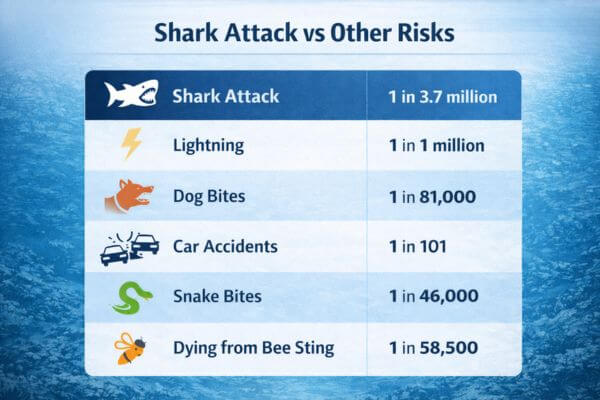
ISAF’s risk comparison page lists the lifetime odds of death from shark-related causes at about 1 in 4,332,817. Its comparison tables also show that lightning and many other accidental causes of death are far more common.
So the real takeaway is:
- Shark bites are serious
- Fatal shark bites are rarer still
- The average person faces many more risks in everyday life
Shark attack statistics thoughts
Shark attack statistics show that two things can be true at once: shark bites are real and should be taken seriously, but they are still rare on a global scale. The numbers remain low; most confirmed unprovoked incidents are non-fatal; and year-to-year spikes do not automatically signal a long-term trend.
Understanding the real data helps replace fear with perspective. Sharks are an important part of healthy marine ecosystems, and a fact-based approach gives readers a far better understanding than sensational headlines ever could.
If you’re ready to move beyond the myths and experience these incredible ocean predators for yourself, you can explore safe, guided shark encounters with divewithsharks. Seeing sharks in their natural environment often changes fear into respect and gives you a completely different appreciation for these misunderstood animals.